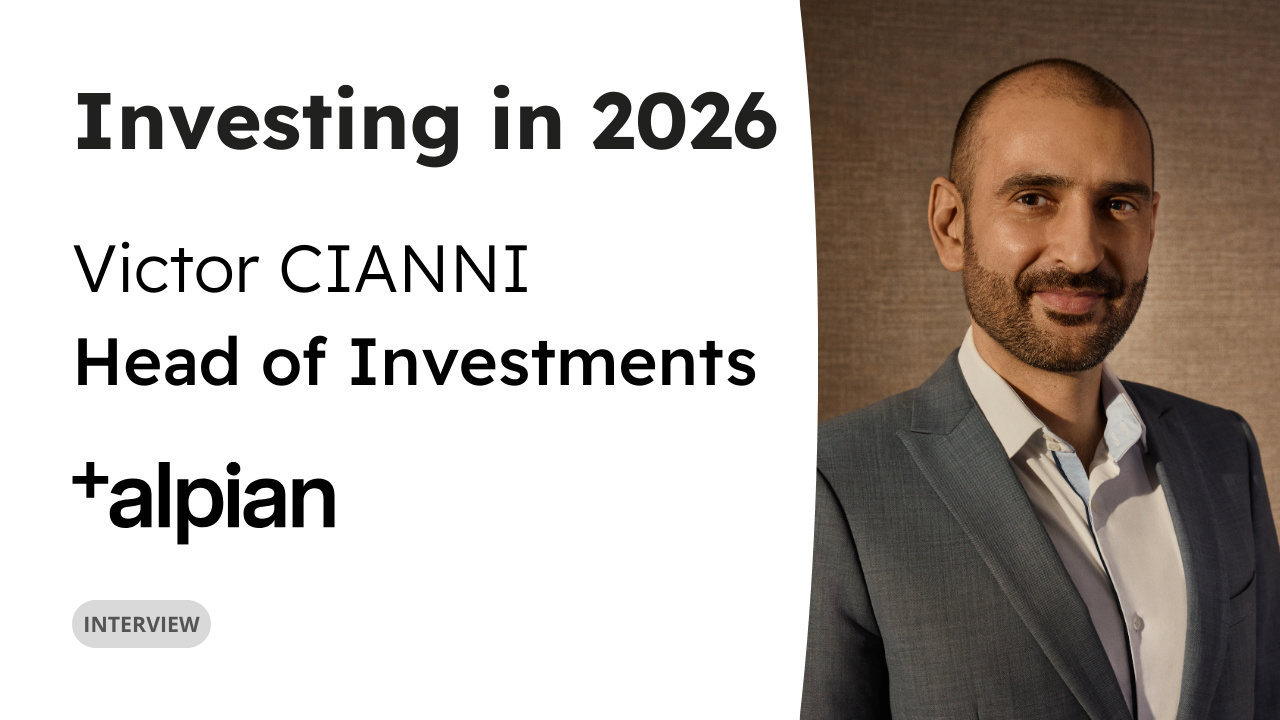
Investing in 2026 – Interview with Victor Cianni, CIO of Alpian

[Interview conducted on March 12, 2026]
Inflation, interest rates, the risk of asset bubbles and geopolitical tensions continue to weigh on markets. In this context, private investors must above all make coherent and well-structured investment decisions.
In this interview, Victor Cianni, Chief Investment Officer at Alpian, shares his outlook for markets in 2026, the key themes to watch and the allocation principles investors should prioritize. He also explains how discretionary portfolio management and an approach that integrates retirement planning can bring clarity and discipline in a complex environment.
How would you describe the market environment at the start of 2026?
Si je devais résumer la situation en un mot, ce serait « mouvementée ». Ces derniers mois, une nervosité croissante était déjà perceptible chez les investisseurs, avec des marchés évoluant globalement sans direction claire. Le déclenchement du conflit impliquant l’Iran a clairement ajouté une nouvelle source de tension.
Markets must now react to events that far exceed mere economic fundamentals. Geopolitics has emerged as a central factor, naturally fueling volatility.
That said, this turbulence is an integral part of investing. It is uncomfortable, but useful. It is precisely during these phases that the strength and resilience of portfolios are tested.
What are the major themes that will shape the markets this year?
The situation in the Middle East is expected to continue to weigh on markets for some time. History shows that markets eventually look beyond conflicts, even if the human cost endures. But it is still far too early to consider this adjustment complete.
Iran occupies a geopolitical nerve center, and tensions in the region can quickly escalate, with broader economic repercussions.
Added to this are the major issues that marked 2025 – the recomposition of the world order, inflation, the sustainability of the AI boom – which will remain central concerns in 2026. Not to mention the unknowns, which are an integral part of the equation.
In such an environment, remaining disciplined is essential. While awaiting a more stable context, our role remains unchanged: to build portfolios robust enough to navigate these periods.
What types of assets could perform well? And what pitfalls should be avoided?
In a more uncertain environment, we believe it is more essential to build the core of the portfolio well than to multiply tactical adjustments. It is primarily a matter of discipline.
At Alpian, we have long believed in international diversification. The past year has reinforced this. In times of geopolitical tension, it is often relevant to look beyond the usual geographical areas that dominate portfolios.
In our view, investing is not about guessing which asset will outperform tomorrow, but about building a balanced portfolio capable of performing in different scenarios, and then knowing when to act when markets offer genuine entry points.
The main pitfall, however, lies elsewhere: managing one’s own emotions. This is probably half the battle. And in the current environment, they will inevitably be put to the test.
In this context, how do you construct Alpian’s discretionary mandates for 2026?
In summary, while market conditions evolve from year to year, the fundamental drivers of growth remain unchanged. The foundations upon which we build our portfolios for 2026 are therefore a continuation of 2025: global diversification, disciplined allocation rather than market timing, and alignment with each investor’s profile.
Of course, we adjust our approach as conditions evolve. For example, we approached 2026 with a deliberately conservative positioning, which proved appropriate. And when volatility creates opportunities, we seek to seize them selectively.
This is the approach we advocate at Alpian. Portfolios based on sustainable principles, designed to deliver performance over time, and actively managed to adapt to a constantly evolving environment.
Your approach is presented as a balance between human advice and technology. What does this hybrid model mean for clients in practice?
In practice, technology eliminates friction, while human judgment provides insight.
When a client opens the app, they get real-time access to their portfolio’s performance, can adjust their risk profile, transparently track fees, and directly contact a licensed advisor. However, when markets evolve and the implications for a specific situation need to be understood, that requires discussion. This is where our advisors come in. Our goal is not to replace this relationship, but to eliminate anything that might make it slow or opaque.
The result is a premium client experience, without being inaccessible. We position ourselves halfway between traditional Swiss private banking, often exclusive to the point of being exclusionary, and fully autonomous solutions, which are efficient but sometimes solitary.
What investor profiles are currently choosing Alpian mandates? Has there been an evolution compared to previous years?
We support a wide range of investors, with solutions accessible from CHF 2,000. However, adoption is strongest among 30-50 year olds with CHF 100,000 to CHF 2 million in assets.
Our approach appeals to individuals who have already built significant savings and are looking for both professional guidance and a seamless digital experience.
What has evolved most is the depth of engagement. Clients initially came for digital simplicity; now they come for performance. Good results translate into clients arriving with more assets, more questions, and clearer objectives.
We also observe growing interest from more affluent clients, for whom access to a dedicated advisor becomes a natural expectation, and for whom the value of our service continues to strengthen.
Alpian launched a Pillar 3a offering in 2025. How do you concretely integrate it into an overall wealth management strategy?
The integration of Pillar 3a is not just a simple product launch, but a thoughtful step towards a holistic approach to wealth management.
Historically, Swiss clients have managed their Pillar 3a separately, often via a low-interest account with their main bank, without truly considering its connection to the rest of their assets. In our view, this is a missed opportunity.
Our affiliation with the Intesa Sanpaolo group gives us access to resources that most digital banks do not have. This has allowed us to integrate the BlackRock fund range and launch an exclusive 3a product, in partnership with Lemania Pension and its foundation, available in eight strategies, from Swiss exposure to global allocations.
At Alpian, Pillar 3a is fully integrated into your investment portfolio and spending account. We guide you in a holistic approach to asset allocation, not in silos.
Finally, with recurring payments now available in the app, the experience becomes truly seamless. You set it up once, and everything happens automatically, with centralized tracking.
Over the next 3 to 5 years, how do you see digital investment evolving in Switzerland, and what role does Alpian intend to play?
The digital investment landscape in Switzerland is progressing but still lags behind international standards in financial innovation. At the same time, client expectations have evolved. Investors are better informed, seek more control, and expect more modern tools, especially as AI transforms the relationship with financial services.
Yet, most platforms continue to impose a binary choice between self-managed and fully delegated management, leaving little room for truly relevant support.
At Alpian, we believe the future is hybrid. A global view of your finances, supported by the right level of advice, at the right time, and delivered in the right way. This is precisely the positioning we aim to embody.
What advice would you give to someone who wants to invest seriously in 2026 but is still hesitant?
If you want to invest seriously but are still hesitant, the first step is to understand why. In most cases, there are only three reasons.
The first is simple and perfectly legitimate: you are not sure you can afford to lose money. This is a healthy concern. Investing should never come at the expense of your financial stability. Start by reviewing your budget and overall situation. Confidence in investing primarily comes from knowing that the rest of your financial life is solid.
If you have the capacity to invest but hesitation persists, it is often due to a lack of conviction. You should invest because it is part of a coherent financial strategy and you understand its benefits: building wealth over time, preserving your purchasing power, and not because a friend told you it was interesting or because everyone else seems to be doing it.
Finally, if you can invest and are convinced it makes sense, the last reason is usually related to the context. Markets seem uncertain, and the news is anxiety-inducing. This discomfort is real, but it is also permanent. Uncertainty never disappears. What you need to keep in mind is that returns exist precisely because risk exists.
About Victor Cianni
Victor Cianni has been Head of Investments at Alpian since 2021, where he leads the digital private bank’s investment strategy. Before joining Alpian, he held several management positions within investment teams at CA Indosuez, Lombard Odier, and Citi Private Bank. He is a graduate of the National Institute of Applied Sciences of Lyon.